

Race Across the World’s Most Ambitious Finish
There’s a moment in Race Across the World Series 6 where the scale of what the contestants are doing really hits you. It’s somewhere around Kazakhstan. The landscape has changed completely. The cities are unfamiliar. The distances between places are enormous. And the finish line, a remote resort beside Lake Hövsgöl in northern Mongolia, still feels impossibly far away.
For most British travellers, Central Asia sits firmly in the “would love to but never quite got round to it” category. It feels complicated. Remote. Hard to plan. The kind of thing you do eventually, when the mood is right.
Race Across the World Series 6 makes a compelling case for moving it up the list. The route through Kazakhstan, Uzbekistan, Kyrgyzstan and Mongolia follows much of the ancient Silk Road, the network of trade routes that connected China to the Mediterranean for over a thousand years, and the destinations along it are, without exception, extraordinary.
Here’s what the teams passed through, and why it’s worth your serious consideration.
Kazakhstan
Kazakhstan is the world’s largest landlocked country, and the one that tends to surprise visitors most. The teams arrived into Aktau, a port city on the Caspian Sea – itself a remarkable geographical oddity, a body of water the size of a small sea with no outlet to any ocean.
Most visitors to Kazakhstan come through Almaty, the former capital and still the country’s largest city. It sits in the foothills of the Tian Shan mountains, with peaks over 4,000 metres visible on a clear day from the city centre. The skiing at Shymbulak, about 25 kilometres from the city, is genuinely world-class and almost entirely unknown outside the region. The Kok-Tobe hill, reached by a Soviet-era cable car, gives you one of those “this is not what I expected” moments that good travel is built on.
The more recently built capital, Astana (formerly Nur-Sultan, formerly Astana again – it’s had a complicated decade), is a fascinating contrast. Built largely from scratch on the steppe since the 1990s, it’s a city of futuristic architecture, enormous public buildings and wide empty boulevards that feels unlike anywhere else in the world. Architecture enthusiasts in particular tend to find it completely absorbing.
Between the cities, Kazakhstan is vast, largely empty and, in the right mood, profoundly beautiful. The steppe stretches to every horizon. The sky is enormous. It’s not a comfortable destination in the way that, say, Greece is – but for the right traveller, that’s exactly the point.

Uzbekistan
If Kazakhstan surprises, Uzbekistan tends to overwhelm. The historic cities of the Silk Road, Samarkand, Bukhara, Khiva, are simply some of the most spectacular places in the world, and they are nowhere near as visited as they deserve to be.
The Race Across the World teams’ checkpoint was at Zaamin National Park, a forested mountain reserve in the centre of the country that offers a different side of Uzbekistan to the famous cities. But it’s Samarkand and Bukhara that most visitors come for, and rightly so.
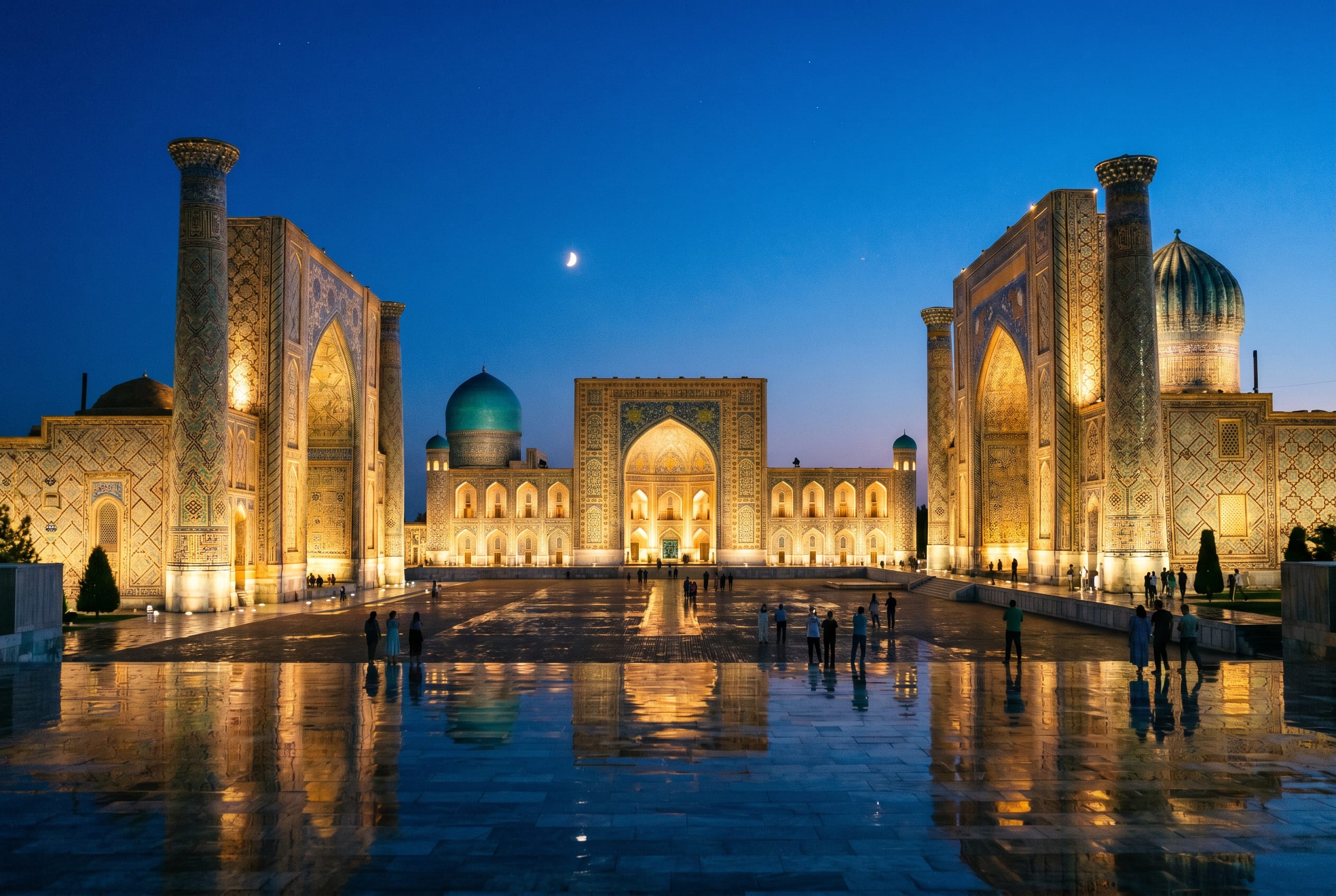
Samarkand is one of the oldest continuously inhabited cities on Earth. The Registan, a square flanked by three enormous medieval madrasas covered in intricate blue and turquoise tilework, is the centrepiece, and it’s one of those places where photographs genuinely do not prepare you for the reality. The scale, the colour and the detail of the architecture are staggering. Tamerlane, who made Samarkand the capital of his empire in the 14th century, brought craftsmen from across Asia to build here, and the results have survived remarkably well.
Bukhara, largely intact within its old city walls, has a different character – more lived-in, more atmospheric in some ways. The Kalon minaret, which has stood since 1127, and the covered bazaars that still operate as markets feel genuinely connected to the Silk Road history rather than simply commemorating it.
Khiva, to the west, is smaller and perhaps the most visually complete of the three, an almost entirely preserved walled city where the scale is human enough that you can walk it properly in a day.
Uzbekistan has made significant efforts to open itself up to tourism over the past decade, and the infrastructure has improved considerably. Direct charter flights from the UK to Tashkent run during the main season, and a growing number of specialist operators offer Silk Road itineraries that combine all three cities.
Kyrgyzstan
Kyrgyzstan appeared briefly in the race as the teams moved eastward through Central Asia, and it’s a destination that rewards the curious traveller enormously.
Where Uzbekistan’s appeal is primarily historical and architectural, Kyrgyzstan is about landscape and culture. The country is over 90% mountains, with the Tian Shan range running across it and peaks that rival anything in the Alps. Lake Issyk-Kul, in the northeast, is the second-largest alpine lake in the world by volume and has a permanently mild microclimate despite sitting at 1,600 metres – it doesn’t freeze in winter, which explains the name, which translates as “warm lake.”
The nomadic traditions of Kyrgyz culture are still genuinely alive here in a way they aren’t in many Central Asian countries. Staying in a yurt camp in the Kyrgyz highlands, particularly in the Song-Kul plateau region, is an experience that has no real equivalent elsewhere. The hospitality is remarkable, the landscape is unlike anything in Europe, and the horses are everywhere.
Bishkek, the capital, is a Soviet-era city that’s considerably more relaxed and cafe-friendly than its background might suggest. It makes a practical base for exploring the country and has enough going on to be worth a day or two in its own right.

Mongolia
The finish line for Race Across the World Series 6 was Hatgal, a small settlement on the southern shore of Lake Hövsgöl in northern Mongolia – one of the most remote and beautiful spots the show has ever chosen as a destination.
Lake Hövsgöl holds roughly two percent of the world’s fresh surface water and sits in a landscape of forests and mountains that feels genuinely untouched. The area around it is home to the Tsaatan people, reindeer herders who live further north in the taiga and represent one of the last nomadic reindeer-herding cultures on Earth.
Mongolia as a destination for British travellers tends to inspire strong reactions – either immediate fascination or mild alarm at the logistics. The logistics are genuinely worth thinking about, but the fascination is entirely justified.
The Gobi Desert covers the southern third of the country and is nothing like the sand-dune Sahara of most people’s imagination; it’s a cold desert of gravel plains, dramatic rock formations like the Flaming Cliffs of Bayanzag (where Roy Chapman Andrews discovered the first known dinosaur eggs in 1923), and wildlife including the rare Bactrian camel and snow leopard. In the north and centre, the steppe and highland forests hold a nomadic culture that, even today, is built around horses and the seasons.
Ulaanbaatar, the capital and home to roughly half the country’s population, is chaotic, interesting and a necessary gateway to the rest of Mongolia. The Gandan Monastery is the country’s most important Buddhist site and is still active. The National Museum of Mongolia gives you a solid grounding in the history of the empire that, at its peak in the 13th century, was the largest contiguous land empire in history.
Getting the most out of Mongolia means getting out of the capital. The Naadam festival in July, three days of wrestling, horse racing and archery, held across the country, is one of the great cultural events in Asia and increasingly popular with international visitors. Travelling with a specialist operator who can arrange ger (yurt) stays with nomadic families and guided access to the more remote areas makes an enormous difference.

The Silk Road as a Trip
One of the most appealing things about this part of the Race Across the World route is how naturally the countries combine into a single journey.
A classic Silk Road itinerary might spend three or four days in Almaty, fly to Tashkent and spend a week covering Samarkand, Bukhara and Khiva, then head to Bishkek for a few days in Kyrgyzstan before flying home. Add a week in Mongolia as a separate trip or a longer extension, and you have one of the most genuinely different holidays it’s possible to take from the UK.
These are not mainstream destinations in the way Türkiye or Greece are, and the planning requires a bit more thought. Specialist knowledge makes a real difference here, knowing which operators handle these regions well, how to combine the countries efficiently, and what the realistic expectations for accommodation and infrastructure look like.
The team at Spear Travels can help you work out whether a Silk Road journey is right for you, and put together an itinerary that does justice to one of the world’s most extraordinary travel corridors – no budget sprint required!
Rather speak to someone in person?